

Have you seen people tracking multiple positions on Google Map? Yes, it is not a new thing to you but it becomes quite difficult for people to automatically update the multiple marker position on Google map dynamically. Here I have brought to you the same code from Google map expert programmer which will let you track multiple positions at the same time. I have simplified the things for you it’s just when you update lat, lng on database, position of marker will update automatically.
[wp_ad_camp_1]
Html Code :
<!-- load google apis script-->

<script src="http://maps.googleapis.com/maps/api/js?key=YOUR_KEY&js?sensor=false&extn=.js"></script>

<!-- css for map -->

<style type="text/css">

#map-canvas
{
height: 400px;
width: 500px;
}

</style>

<!--map appear on this div -->

<div id="map-canvas"></div>
JavaScript Code:
var locations = {}; //A repository for markers (and the data from which they were contructed).

//initial data set for markers

var locs = {

1: {

info: 'user1',

lat: 22.7377,

lng: 75.878

},

2: {

info: 'user2',

lat: 22.7149,

lng: 75.8432

},

3: {

info: 'user3',

lat: 22.7190,

lng: 75.8972

}

};

var map = new google.maps.Map(document.getElementById('map-canvas'), {

zoom: 9,

maxZoom: 21,

minZoom: 1,

streetViewControl: false,

center: new google.maps.LatLng(22.7533, 75.8937),

mapTypeId: google.maps.MapTypeId.ROADMAP

});

function setMarkers(locObj) {

$.each(locObj, function (key, loc) {

if (!locations[key] && loc.lat !== undefined && loc.lng !== undefined) {

//Marker has not yet been made (and there's enough data to create one).

//Create marker

loc.marker = new google.maps.Marker({

position: new google.maps.LatLng(loc.lat, loc.lng),

//icon: 'logo.png', //Marker icon).

map: map

});

var infowindow = new google.maps.InfoWindow();

infowindow.setContent('<span style="color:#EA2E49;font-weight:bold">'+loc.info+'</span>');

infowindow.open(map, loc.marker);

//Attach click listener to marker

google.maps.event.addListener(loc.marker, 'click', (function (key) {

return function () {

infowindow.setContent(locations[key].info);

infowindow.open(map, locations[key].marker);

}

})(key));

//Remember loc in the `locations` so its info can be displayed and so its marker can be deleted.

locations[key] = loc;

} else if (locations[key] && loc.remove) {

//Remove marker from map

if (locations[key].marker) {

locations[key].marker.setMap(null);

}

//Remove element from 'locations'

delete locations[key];

} else if (locations[key]) {

//Update the previous data object with the latest data.

$.extend(locations[key], loc);

if (loc.lat !== undefined && loc.lng !== undefined) {

//Update marker position (maybe not necessary but doesn't hurt).

locations[key].marker.setPosition(

new google.maps.LatLng(loc.lat, loc.lng));

}

//locations[key].info looks after itself.

}

});

}

var ajaxObj = { //Object to save cluttering the namespace.

options: {

url: "process.php", //The resource that delivers loc data.

dataType: "json" //The type of data tp be returned by the server.

},

delay: 500, //(milliseconds) the interval between successive gets.

errorCount: 0, //running total of ajax errors.

errorThreshold: 5, //the number of ajax errors beyond which the get cycle should cease.

ticker: null, //setTimeout reference - allows the get cycle to be cancelled with clearTimeout(ajaxObj.ticker);

get: function () { //a function which initiates

if (ajaxObj.errorCount < ajaxObj.errorThreshold) {

ajaxObj.ticker = setTimeout(getMarkerData, ajaxObj.delay);

}

},

fail: function (jqXHR, textStatus, errorThrown) {

console.log(errorThrown);

ajaxObj.errorCount++;

}

};

//Ajax master routine

function getMarkerData() {

$.ajax(ajaxObj.options)

.done(setMarkers) //fires when ajax returns successfully

.fail(ajaxObj.fail) //fires when an ajax error occurs

.always(ajaxObj.get); //fires after ajax success or ajax error

}

setMarkers(locs); //Create markers from the initial data set served with the document.

ajaxObj.get(); //Start the get cycle.
PHP Code:
// create mysqli connection

$con=mysqli_connect('localhost','root','','MobileApp');

// select data from table

$result=mysqli_query($con,'SELECT * FROM new_user');

$array="";


while ($user=mysqli_fetch_assoc($result)) {

// for testing update lat ,lng manually

$lat=explode('.', $user['lat']);

$lat_part=$lat['1']+10;

$lat_com=$lat['0'].'.'.$lat_part;

$lng=explode('.', $user['lng']);

$lng_part=$lng['1']+10;

$lng_com=$lng['0'].'.'.$lng_part;

//update lat ,lng into table

mysqli_query($con,'UPDATE new_user SET `lat`="'.$lat_com.'",`lng`="'.$lng_com.'" WHERE `id`='.$user['id']);

$array[$user['id']]['info']='<b>'.$user['name'].'</b>';

$array[$user['id']]['lat']=$user['lat'];

$array[$user['id']]['lng']=$user['lng'];

}

echo json_encode($array); //result return in json form

/*PHP array look like this

Array

(

[1] => Array

(

[info] => <b>user1</b>

[lat] => 22.399304

[lng] => 75.1763525

)

[2] => Array

(

[info] => <b>user2</b>

[lat] => 22.1597120

[lng] => 75.1732723

)

[3] => Array

(

[info] => <b>user3</b>

[lat] => 22.1630125

[lng] => 75.1770120

))*/
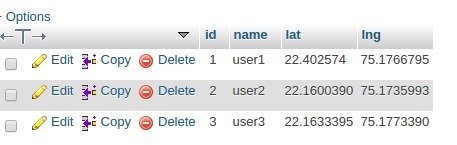
Database table:
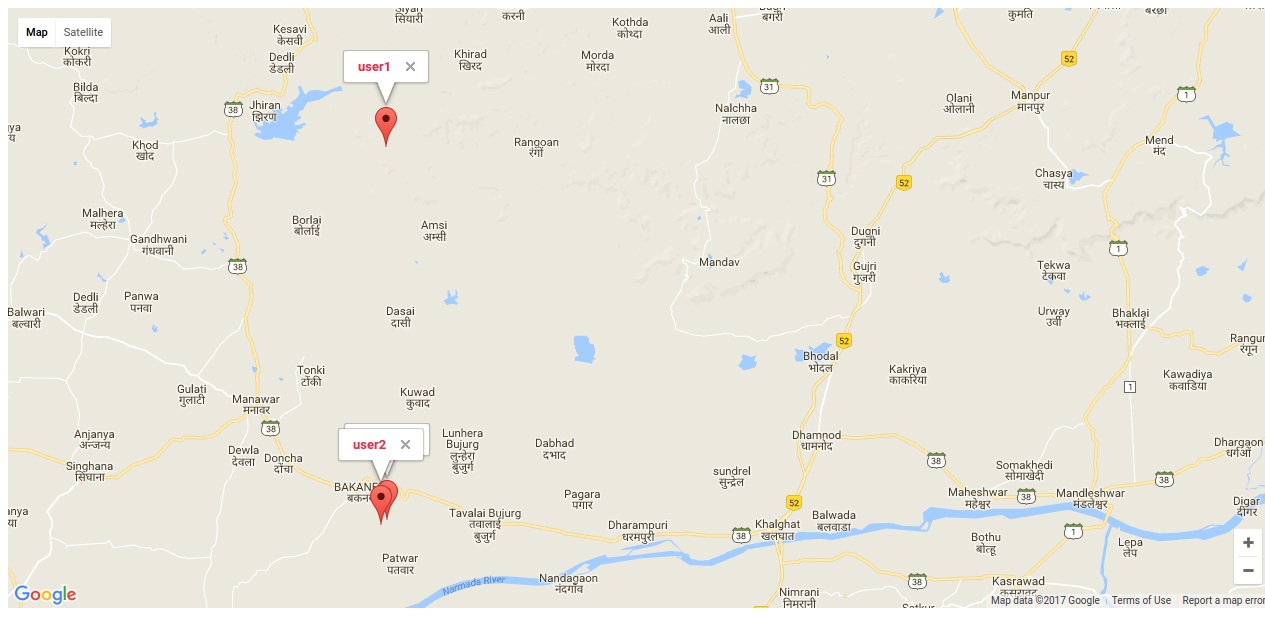
Output display:
Want to get this functionality implemented on your website? Then Hire Expert Web Developer. Or want to know more about such technical stuff? Read my Blog.